Over the past months, we’ve been asking a simple but loaded question: What will live production look like in 2035?
To explore that, we ran a new research project: Vision 2035: Innovations Guide, a survey-driven look at how people working in and around live production expect workflows and technology to change over the next decade.
In this three-article series, we’re sharing some of the early patterns that emerged: (1) what’s driving change today, (2) how workflows are expected to evolve, and (3) how AI, trust, and sustainability fit into the picture.
This article zooms in on the first of those threads: What pressures are live production teams feeling right now? And how do they expect those pressures to show up in their workflows over the next few years?

The two big forces are economics and audience reality
When we asked, “What is currently driving the most change in your production environment?”, respondents pointed to a combination of economic and audience factors. Across the responses and commentary, three themes kept showing up:
- Budget pressure and efficiency demands: Budgets are tight, even as expectations grow. Respondents discussed the need to produce more content across more platforms, without a corresponding increase in headcount or capital spend.
- New audience expectations and multi-platform delivery: Audiences want more of everything, and more content tailored to their interests. That’s a growing challenge when content has to land across linear, streaming, FAST, social, in-venue, and owned platforms.
- Skills and talent constraints: Skill and talent shortages are very real, adding pressure to build flexible, distributed workflows and multifunctional roles instead of relying on a large, highly specialized on-site team for every production.
We could sum up these drivers as a push to “make more, for more people, in more places.” That backdrop is important: conversations about IP, cloud, and AI aren’t happening in isolation. They’re about finding practical ways to deal with those pressures.
Most teams are trying to keep workflows flexible so they can do more with the same or fewer resources. Several contributors described this as a shift away from big, highly specialized stacks and toward multi-purpose content creation platforms that can handle a broader range of shows.
Near-term tech bets: the next five years
To see how those pressures might shape workflows in the near term, we asked: “Which technology will have the most significant impact on your live productions in the next five years?”
Respondents highlighted a handful of technologies that stand out as near-term levers, rather than distant bets:
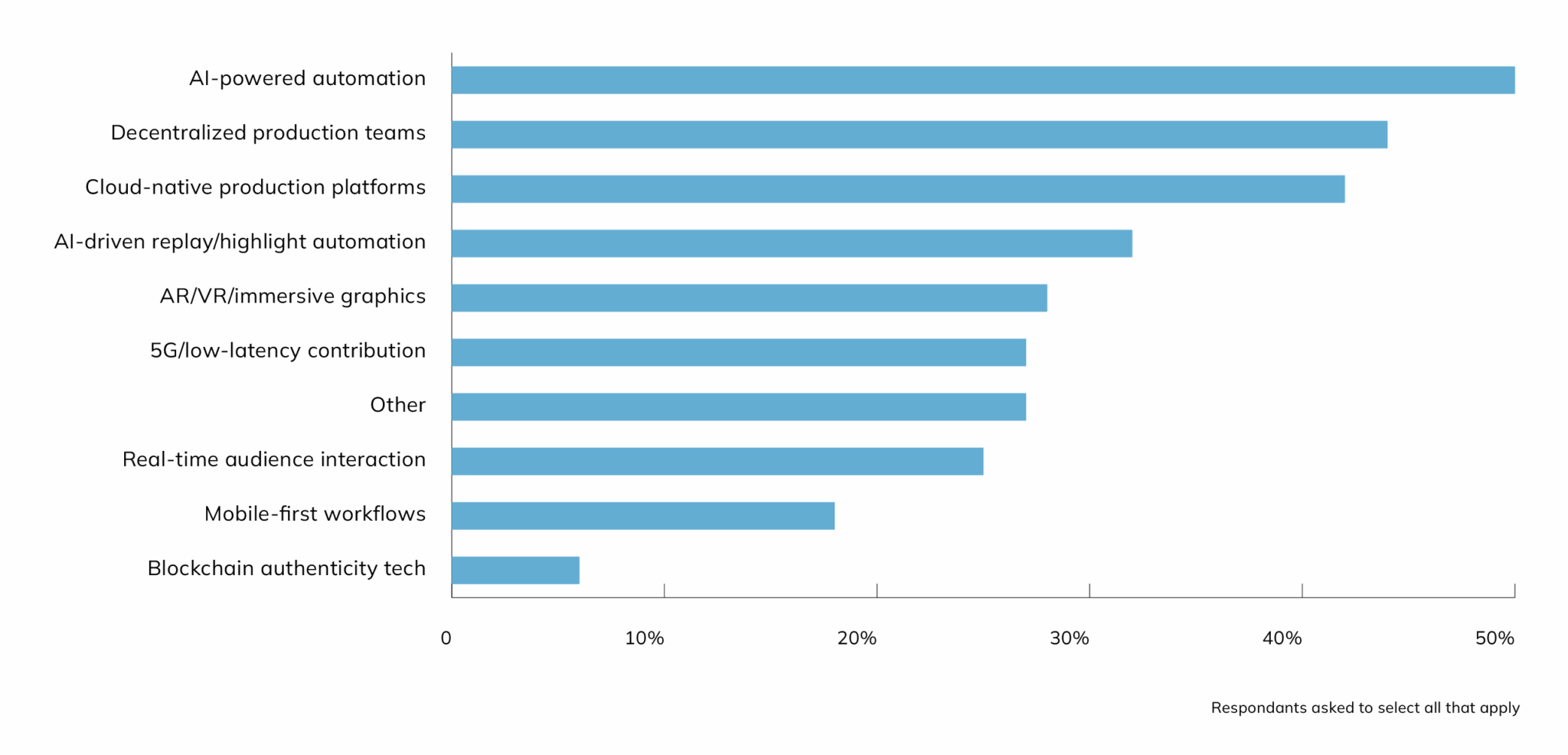
Near term, respondents expect these technologies to show up as AI-powered automation and decentralized teams, enabled by cloud-native platforms with improved latency and connectivity. It’s a pragmatic mix: move certain workloads to cloud compute where elasticity and reach help, then add assistive AI to multiply the output per operator.
- Assistive automation, not full autonomy: Our experts broadly agree that the pressure to do more with the same resources will push teams toward assistive automation and distributed productions enabled by cloud-native tools, better connectivity, and orchestration.
- Distributed, consolidated teams: As productions become more distributed, technical positions continue to consolidate, with multi-skilled operators handling multiple roles and not always being in the same room—or even the same city.
- From specialist stacks to flexible platforms: Under pressure to produce more with less, many established content providers are moving away from big, specialist stacks toward tools and workflows that can be repurposed for higher throughput. They’re building multi-purpose content creation platforms to meet expectations for content that’s more personal, more immediate, and available everywhere.
How these pressures feed into investment plans
The same story shows up again when we asked which technologies are priority investments over the next five years. Budgets are favoring the plumbing and the people who use it:
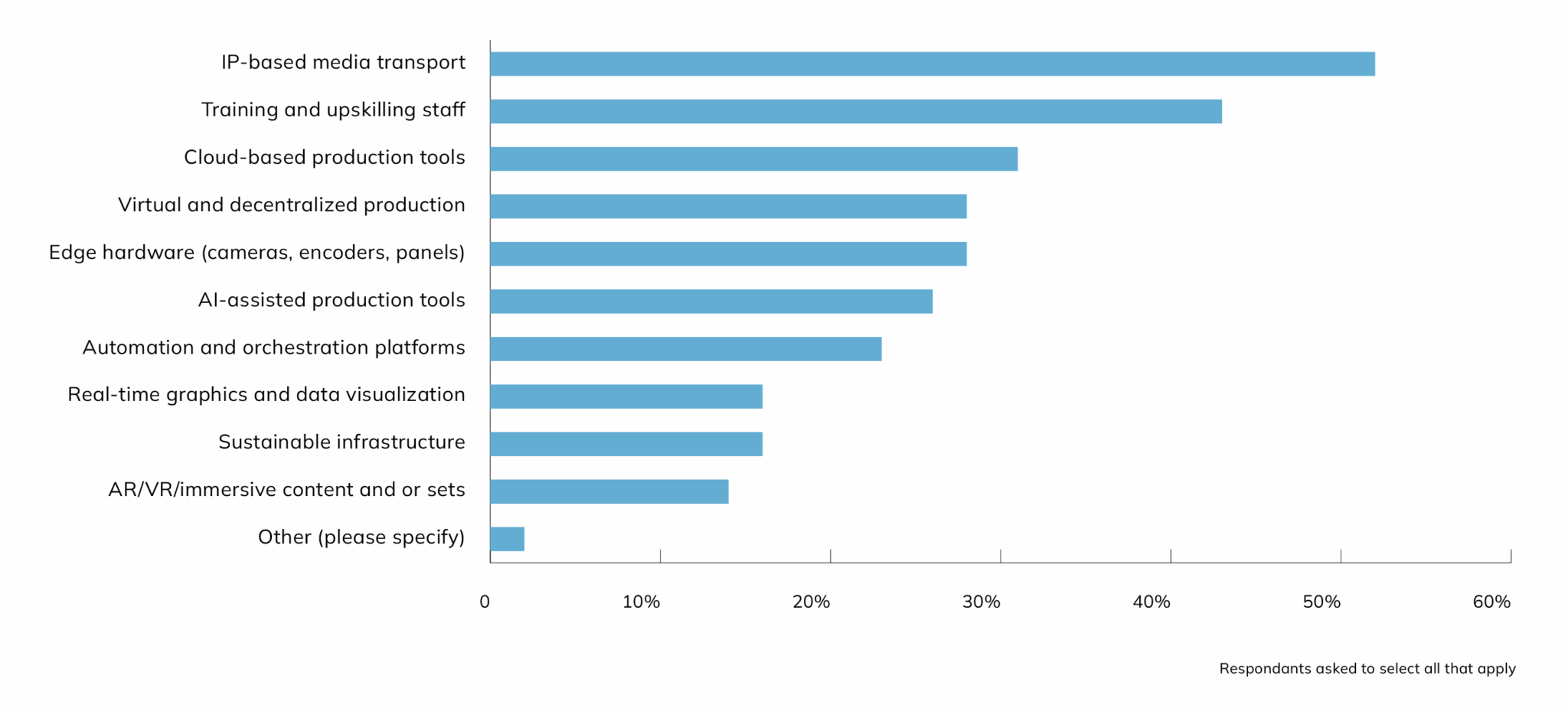
- IP-based media transport emerges as the top investment priority.
- Training and upskilling follow closely behind.
- Efficiency levers like remote/decentralized production, AI-assisted tools, and automation and orchestration platforms directly tie back to the pressures we’ve already seen: more output, the same or fewer people, more platforms.
Storytelling-oriented investments (graphics, data visualization, AR/VR) are still on the list, but they’re framed as more targeted compared to the foundational spend on transport and people. This budget pattern is exactly what a hybrid, assistive-AI, IP-based roadmap looks like in practice: build transport and capability, then let software and AI raise efficiency to maximize the human craft at the core.
What this might mean for your plans today
Vision 2035 reflects the views of a specific group of respondents and therefore doesn’t claim to represent the entire industry. But the patterns in these answers may be helpful as a benchmark when you’re looking at your own roadmap. A few ideas you might bring into internal conversations:
- Start with the pressures, not the buzzwords: Map your situation against the same drivers like budget, audience expectations, and skilled resources to ensure technology decisions respond to those forces, rather than chasing trends for their own sake.
- Look for repeatable, multi-purpose workflows: If the guiding theme is “make more, for more people, in more places,” it’s worth asking: which parts of our workflow can be standardized and reused across shows, and which tools genuinely increase throughput without adding fragility?
- Think “assistive” when you think AI: Respondents are clearly interested in AI and automation, but to multiply what operators can do, not replace them. Focusing on assistive use cases (clipping, versioning, metadata, repurposing) can be a lower-risk way to unlock value early.
- Pair infrastructure decisions with skills planning: IP transport, cloud-native tools, and distributed production all depend on people who are comfortable running them. Training and upskilling showing up as a top investment priority is a good reminder to keep tech and training plans linked.
Vision 2035 Report
Explore what’s ahead for live production through expert opinion.
Leaders across news, sports, entertainment, and live events, all sharing their vision for what production will look like in the next decade.
Where this series goes next
This article has focused on what’s driving change today: the pressures reshaping live production and the technologies respondents expect will help over the next few years. In the rest of this series, we dig into two other big themes from the Vision 2035 responses:
- How infrastructure is expected to evolve, from SDI islands toward more hybrid, IP-enabled workflows.
- How teams are thinking about AI, trust, and sustainability as they plan for the next decade.
If you’re feeling similar pressures in your own operation, we hope these early insights offer a useful reference point and a few angles to bring into your next planning session.