Over the past months, we’ve been asking a simple but loaded question: What will live production look like in 2035?
To explore that, we ran a new research project: the Vision 2035: Innovations Guide, a survey-driven look at how people working in and around live production expect workflows, infrastructure, and technology to change over the next decade.
In this three-article series, we’re sharing some of the early patterns that emerged: (1) what’s driving change today, (2) how infrastructure is expected to evolve, and (3) how AI, trust, and sustainability fit into the picture.
This article zooms in on that third thread: Where are teams already using AI, what do they hope it will unlock, what worries them about it, and how does sustainability fit into the way they’re planning the next decade?
Where AI is already helping today
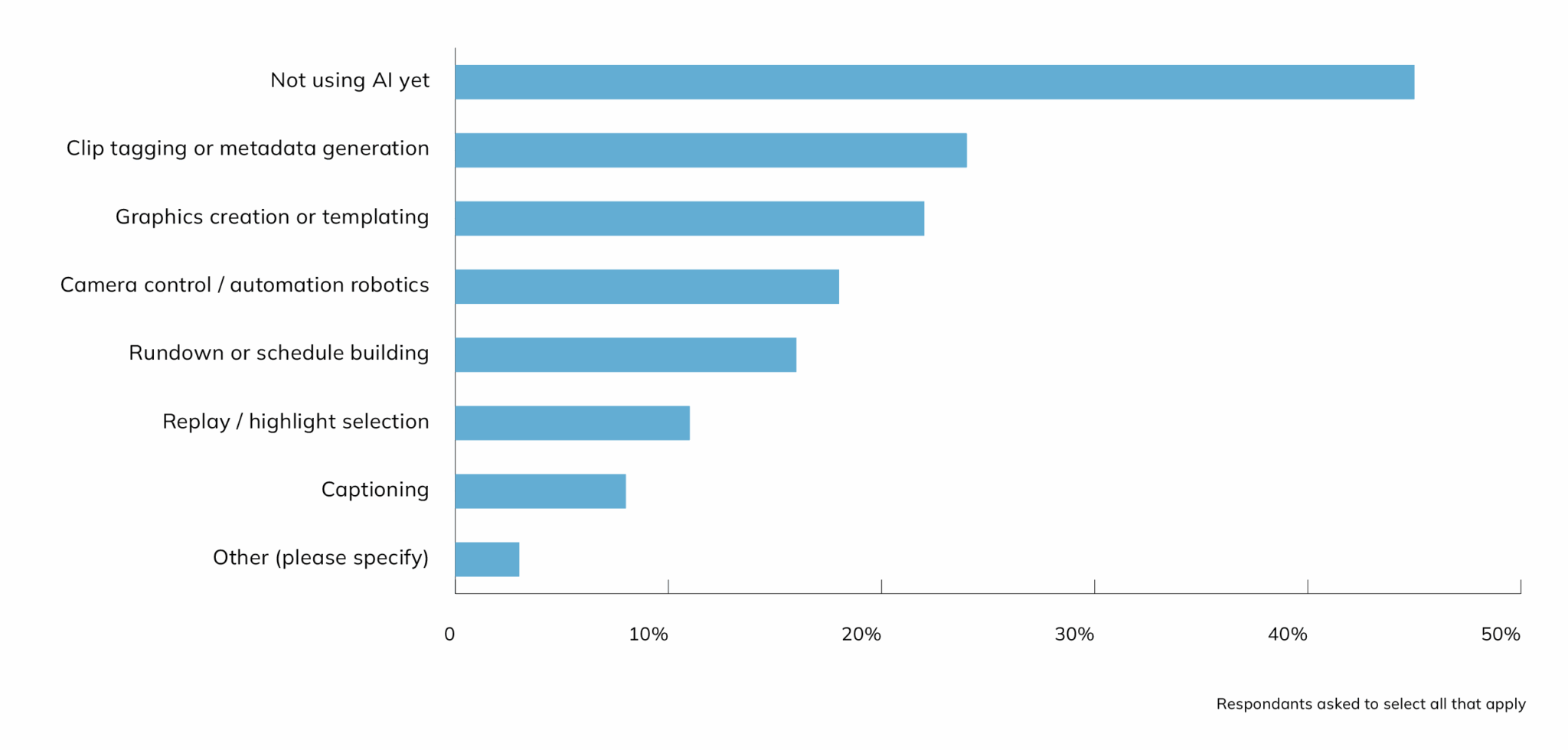
Rather than asking what AI might do one day, we started with a more straightforward question: “Which parts of your workflow are already using or trialing automation or AI?”
Respondents told us that AI and automation are already appearing in their day-to-day workflows, mainly helping with repetitive, version-heavy tasks. The most common current uses include:
Where respondents expect AI to make the biggest difference
Looking ahead, respondents were also asked: “Which areas of live production do you expect will most benefit from AI?”
Their answers point AI at the same version-heavy, repeatable parts of the stack first:
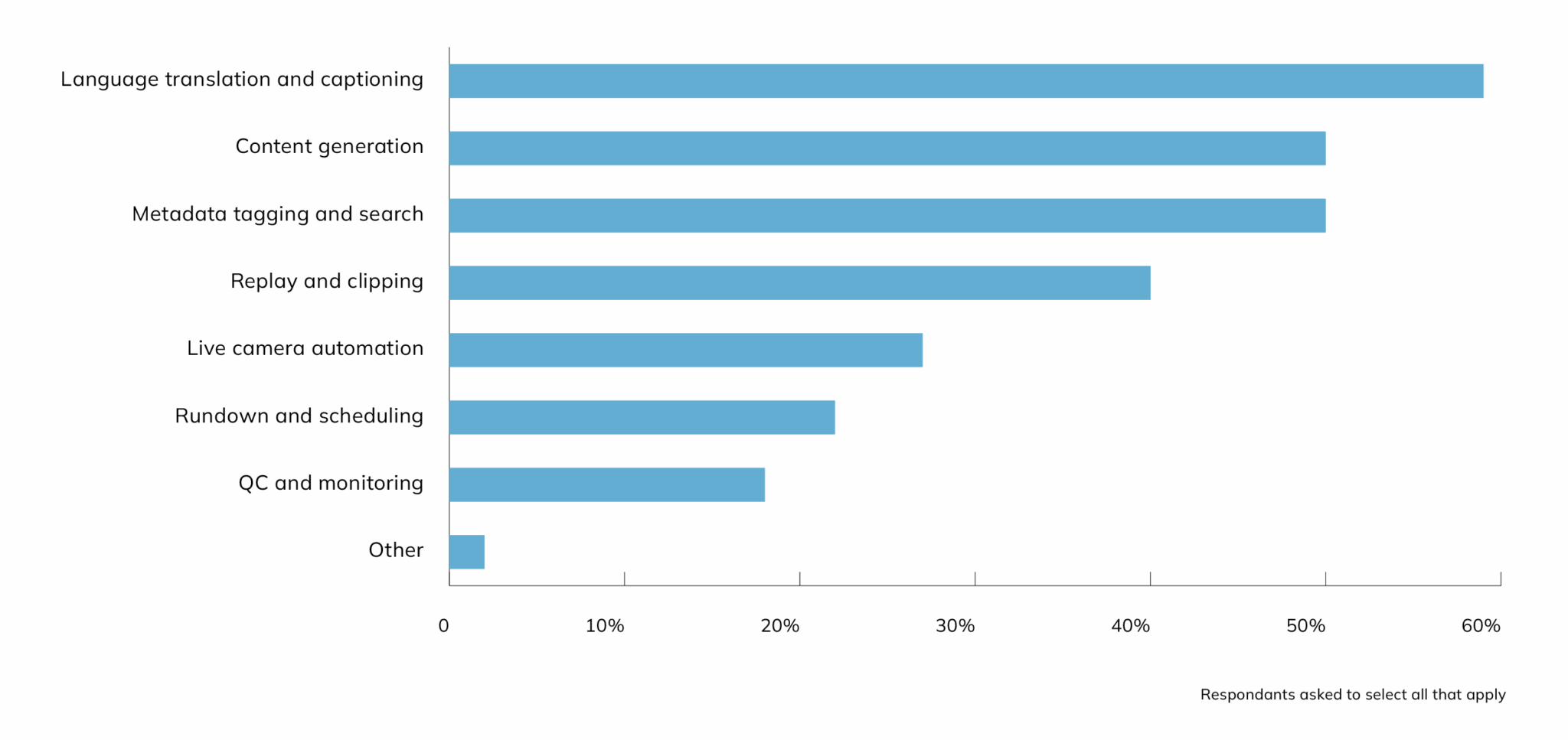
The guide describes this as less a revolution than a workload reallocation: AI supports the “produce once, version to many” reality of modern content, without placing extra load on production teams.
Experts also expect operators to benefit most when AI folds into familiar control surfaces, eventually becoming “just another tool running in the background” that lets multi-skilled operators do more. AI is already beginning to transform our business; within a few years, it’s just going to be how many things are done.
What keeps people cautious about AI
Alongside potential gains, we asked respondents: “What concerns you most about increased AI use in broadcast production?”
Their top concerns land exactly where you might expect:
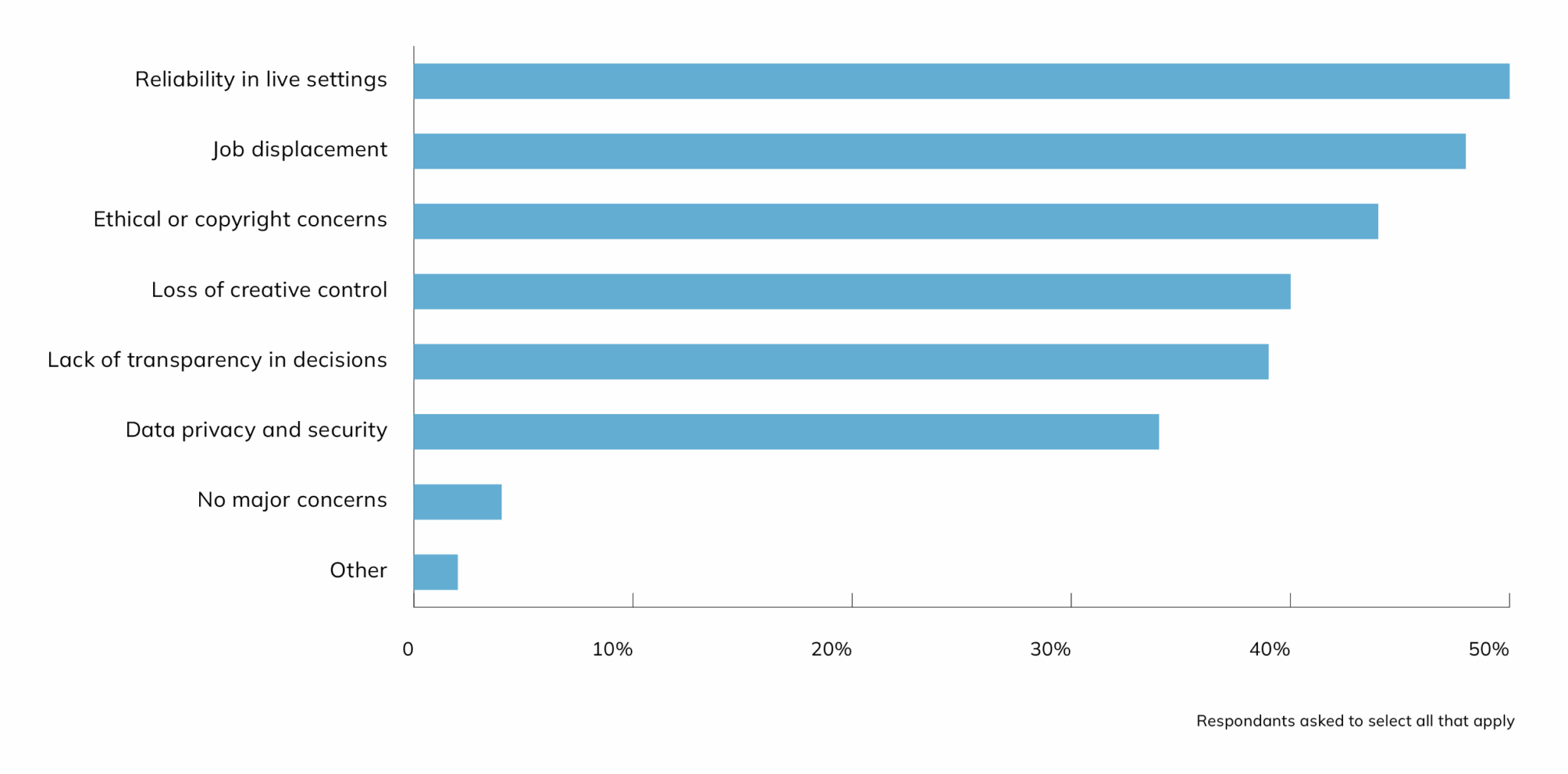
Only a small group reported no major concerns. A recurring theme in both survey responses and expert commentary is that AI should remain a support, not a replacement. Progress here is less about “magic” and more about reliable engineering and good editorial and data hygiene.
One survey participant captures the human side of those concerns: “A lot of what we watch is passion-driven. If you don’t have real people doing the jobs to input the same level of passion, the quality is going to become stale and sterile.”
Why trust and provenance matter more as AI spreads
As AI becomes more capable, respondents and experts also raised a deeper question: how will audiences know what to trust? It’s already getting harder to tell what’s genuine, and brand perception and established trust will likely matter as much as the technology itself.
Several expert comments emphasize provenance and brand equity. There is currently no good way to secure provenance, and the industry may be 5 to 10 years behind in confidently verifying that a video is real.
But established broadcasters still carry weight because of the equity and trust built into them through past performance and accuracy. In practical terms, teams should:
- Prioritize AI in areas where quality is measurable and can be corrected before air, like captioning, localization, and templated workflows.
- Keep human controls on creative choices and anything that touches the brand.
- Prioritize provenance for any output that could affect viewer trust.
That adds up to a simple pattern: use AI to help get more done, but let people at the core remain the anchors of trust.
How sustainability fits into real-world decisions
We also asked: “How important is sustainability when making technology decisions for production?”
Nearly two-thirds of respondents agreed that sustainability is important, but most are not making key decisions based on sustainability alone. Teams still optimize for cost, reliability, and output first. Even so, the guide highlights some notable findings:
- Sustainable infrastructure is a priority investment for a meaningful portion of respondents.
- Remote and distributed workforces can reduce travel costs and environmental impact.
- Hybrid productions with shared compute and memory resources may drive further sustainability gains—something that could be important as AI workloads increase energy use.
In live video production, the biggest footprint is often travel and energy use. Being able to spin resources up and down as required in the cloud or elsewhere can be a differentiator when it improves both content quality and the bottom line.
In other words, sustainability is increasingly appearing as a by-product of more efficient, flexible operations, rather than a standalone goal.
What this might mean for your technology roadmap
Vision 2035 reflects the views of a specific group of respondents and doesn’t claim to represent the entire industry. But their answers do highlight some patterns you may want to keep in mind as you plan your own next steps.
A few ideas you might bring into internal discussions:
- Aim AI at the workload, not the show: Start where AI can clearly remove repetitive work—captioning, tagging, versioning, localization—while leaving creative control and on-air decisions firmly in the hands of human teams.
- Pair every AI initiative with a trust and provenance question: For anything that could affect audience perception, ask: how will we verify this, review it, and stand behind it if there’s a dispute?
- Keep humans at the center of brand-critical work:The survey responses and expert commentary both imply a strong role for people in any work that touches editorial judgment, storytelling, and brand voice, even as assistive tools expand.
- Treat sustainability as an outcome of efficiency moves: Remote production, hybrid infrastructure, and elastic compute often improve both economics and environmental impact. Framing sustainability in those terms can make it easier to align with budget and performance goals.
- Design pilots with clear guardrails: Narrowly scoped trials can help teams gain confidence in AI-assisted workflows without risking marquee properties.
Where this series goes next
This article has focused on how respondents are thinking about AI, trust, and sustainability, what they’re already using assistive tools for, what they hope to gain, and what still worries them. Across all three articles in this series, a consistent picture emerges from the Vision 2035 responses:
- Change is driven by economics and audience reality, not technology for its own sake.
- The likely operating model is hybrid, with an IP backbone and software gradually doing more of the lifting.
- AI is seen as an assistant, not the star, helping teams produce more without eroding trust or creative quality.
If you’re wrestling with similar questions in your own operation, we hope these early insights offer a useful reference point and a few angles to bring into your next planning session, whether you’re thinking about new tools, new workflows, or how to protect the trust your brand has already earned.