Over the past months, we’ve been asking a simple but loaded question: What will live production look like in 2035?
To explore that, we ran a new research project, Vision 2035, a survey-driven look at how people working in and around live production expect workflows, infrastructure, and technology to change over the next decade.
In a three-article series, we’re sharing some of the early patterns that emerged: (1) what’s driving change today, (2) how infrastructure is expected to evolve, and (3) how AI, trust, and sustainability fit into the picture.
This article pulls on one thread that stood out very clearly: How do people expect to get from today’s SDI-centric facilities to a more IP- and cloud-enabled, hybrid future? What follows is a summary of what this survey group told us about that journey, and what you might take from it when planning your own roadmap.

What’s driving change right now?
When respondents were asked what’s driving the most change in their production environments today, three themes consistently rose to the top:
- Budget pressure and efficiency demands
- New audience expectations and multi-platform delivery
- Ongoing technology innovation
In practice, that means most teams are trying to do more with the same or fewer resources, serve audiences who expect content on more platforms, in more formats, and keep up with new tools and workflows that promise to help, but can also add complexity.
The conversation about SDI, IP, and cloud isn’t happening in isolation. It’s happening amid tightening budgets, new viewing habits, and a constant push to work smarter with the people already on staff.
Looking ahead: Where respondents expect the big shifts
We also asked: “What will be the most significant change in live production over the next ten years?”

A few answers clearly stood out:
- “IP overtakes SDI” was the single most selected option, chosen by roughly a third of respondents.
- AI as a production assistant was another major theme.
- Remote and distributed live production, as well as the transition to software-defined tools and infrastructure, also featured strongly.
Taken together, those responses suggest that many teams expect:
- The underlying plumbing of live production to become more IP-centric and software-defined
- AI to layer on top of that infrastructure as an assistive capability rather than a total replacement for human roles
- Production resources and teams to become more distributed by default
At the same time, written comments and expert contributions acknowledge that SDI is unlikely to disappear overnight, especially in cost-sensitive regions and for well-established plants that continue to operate reliably. The tension between “SDI still works” and “IP is clearly coming” runs through many of the answers.
Where will workflows actually live by 2035?
Two questions helped build a picture of how respondents think infrastructure will be structured in the longer term:
- Where do you expect most live production workflows to happen by 2035?
- By 2035, what percentage of your live production workflows do you expect to be cloud-based?
On the first question, only a small minority felt that, by 2035, the majority of workflows would still live in a traditional, centralized on-prem facility. Many more pointed to a hybrid model, where workflows span on-prem, data center, and cloud environments.
On the second question, few responses sat at either extreme of “almost nothing in the cloud” or “everything in the cloud.” Most forecasts clustered around a substantial but not total shift to cloud-based workflows.
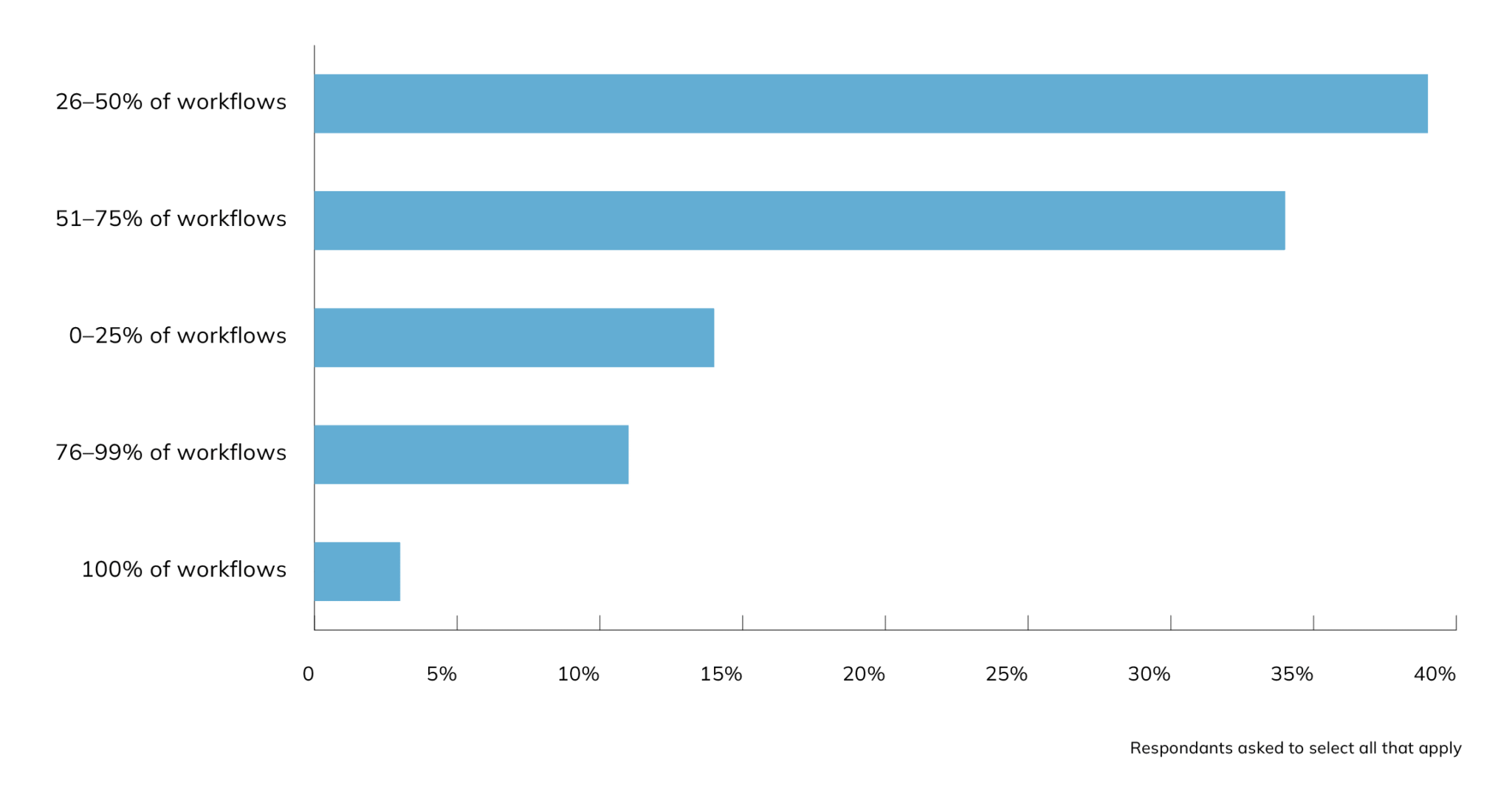
The overall picture looks like this:
- Hybrid becomes the norm rather than pure cloud or pure on-prem
- Cloud is seen as a significant part of the mix, but not the only pillar
- On-prem and dedicated infrastructure remain important, especially where timing, bandwidth, and local control matter most
The guide summarizes this as a “cloud-enabled backbone” rather than a fully virtualized future.
The edge stays physical (for good reasons)
We also asked which parts of the production chain respondents think are least likely to move to the cloud. Here, answers gravitated toward the high-touch, timing-critical parts of live production, including Camera operations and robotics, live switching and vision mixing, branding, and real-time graphics
The reasoning that emerges from the survey and commentary is straightforward:
- Latency and performance matter. For high-stakes, real-time decisions, even small delays are a problem.
- Operator “feel” is hard to replace. Many contributors highlighted the value of physical control surfaces and muscle memory built over years of live production.
So while infrastructure services such as routing, processing, multiviewing, and certain storage or playout functions are seen as strong candidates for virtualization and consolidation, tactile, on-air operations are expected to remain anchored in dedicated hardware and local control for longer.
That doesn’t mean nothing changes at the edge; it simply suggests that respondents see more immediate headroom to move and centralize things in the core first.
How ready are facilities for cloud-only productions today?
To balance the future-focused questions, we included a very practical one: “Do you believe your facility could successfully run a major live event entirely in the cloud today?”
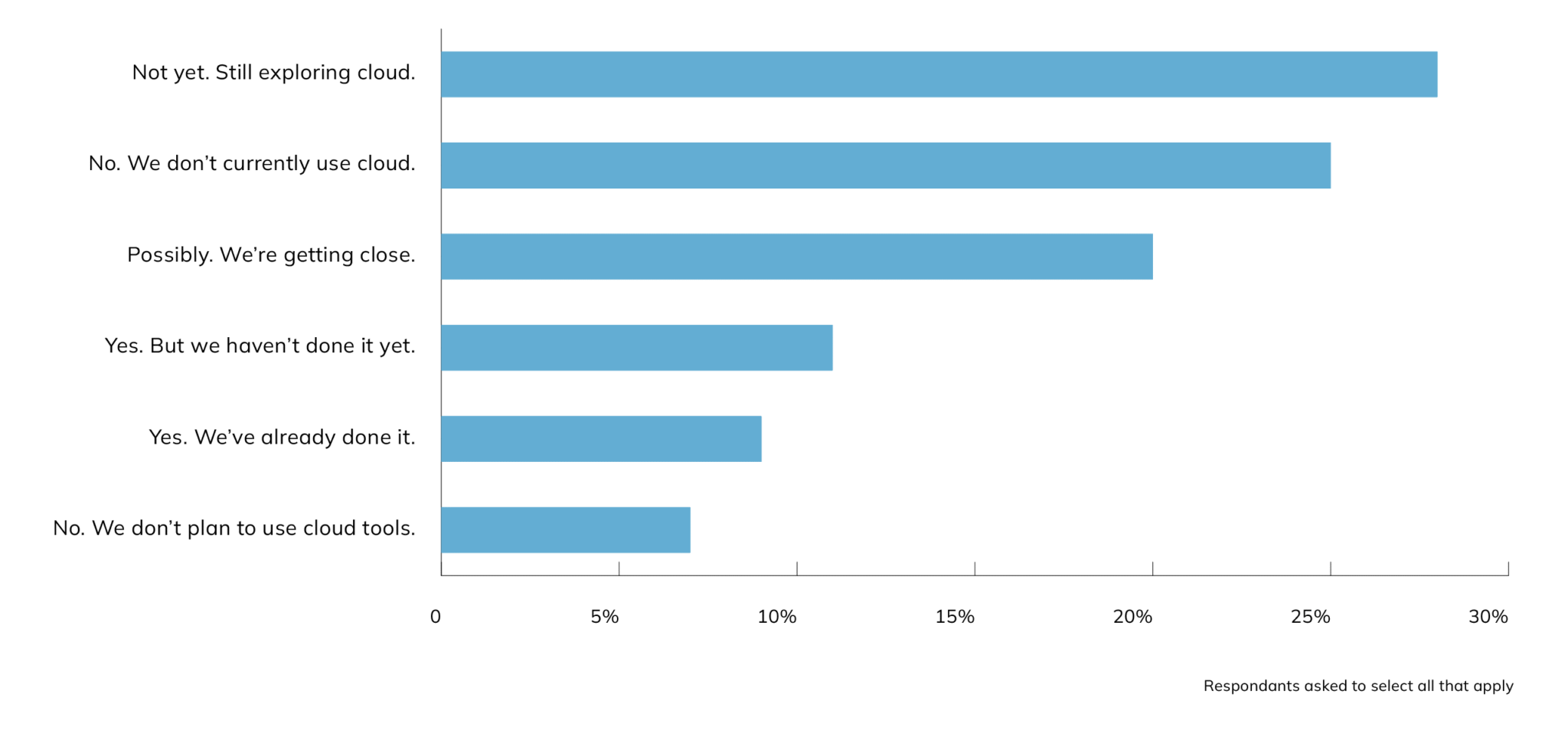
Here, the answers were notably more cautious:
- Less than a quarter of respondents felt confident they could run a major live event fully in the cloud today.
- A significant number indicated they don’t yet use cloud tools at all for live production or are still in the exploration or proof-of-concept stage.
In written responses and expert commentary, concerns about resilience came up regularly—for example, what would happen if a widespread cloud service outage affected a marquee broadcast. The pattern that emerges is that many organizations see cloud as an increasingly important part of their strategy, but are more comfortable using it as a complement to existing infrastructure rather than the sole foundation for their most critical productions right now.
Where investment is heading in the next five years
When asked which technologies they see as priority investments over the next five years, respondents highlighted a mix of infrastructure and people-focused areas, including:
- IP-based media transport
- Training and upskilling staff
- Virtual and decentralized production
- AI-assisted tools and automation
It’s a telling combination. It suggests that many organizations are planning to:
- Upgrade their underlying transport and infrastructure toward IP
- Invest in people and skills, not just equipment
- Use virtualized and remote workflows, plus assistive AI, to get more value from the teams they already have
In the context of the other answers, this looks very much like a practical roadmap toward a hybrid future: build the IP and software foundation, then use AI and automation to raise efficiency while keeping human judgment at the center.
What this might mean for your SDI-to-hybrid journey
Vision 2035 reflects the views of a specific group of respondents and doesn’t claim to speak for the entire industry. But their answers do highlight some patterns that may be useful as you shape your own plans.
A few themes you might take into your next roadmap discussion:
- Plan for hybrid, not a single leap: Many respondents appear to be working toward a world where IP and cloud are core parts of the infrastructure, but not the only pillars. That points toward roadmaps built around phased projects rather than an all-or-nothing migration.
- Virtualize the core before you virtualize everything: The distinction between “core services” and “edge operations” shows up clearly. Routing, processing, multiviewing, and some playout or storage functions are strong candidates to move into shared compute and IP fabrics, while cameras, panels, and certain on-air roles may stay physical for longer.
- Treat cloud as strategic capacity: In the near term, cloud looks most attractive for scaling up during peaks, experimenting with new workflows, or supporting additional productions—with hybrid models providing a safety net for mainline events.
- Invest in both plumbing and people: The emphasis on IP transport alongside training suggests that respondents see technology and skills as two sides of the same coin. New infrastructure without operator confidence is unlikely to deliver the results they’re looking for.
Bringing it back to your next upgrade cycle
If there’s one common thread through these responses, it’s that most teams aren’t planning for a dramatic “SDI off, cloud on” moment.
Instead, they’re picturing a series of practical steps:
- Gradually tilting new investments toward IP and software-defined tools
- Virtualizing core services where it makes sense
- Keeping the edge grounded in operator confidence and real-time performance
- Using cloud as an important part of the mix, not the only pillar
For some organizations, that might start with a single hybrid control room or an IP-ready truck. For others, it may mean piloting a cloud-based workflow around secondary shows while mainline productions remain firmly hybrid. In every case, the path looks incremental rather than all-or-nothing.
This article has focused on one dimension of the survey: the journey from SDI islands toward a more hybrid, IP-enabled future. In the rest of this series, we’ll look at two other big themes that came through strongly in the Vision 2035 responses:
- The pressures and priorities driving change in live production today
- How teams are thinking about AI, trust, and sustainability as they plan for the next decade
If you’re wrestling with similar questions in your own facility, we hope these early insights offer a useful benchmark—and a few ideas to bring into your next upgrade cycle. Keep an eye out for subsequent articles in this series and for the full Vision 2035: Innovations Guide when it’s released.