Modern sports fans have the luxury of high-definition displays, real-time stats, and multi-angle replays at home. To compete, sports venues must deliver synchronized, immersive experiences—not just bigger screens.

Picture this scenario. It’s a Saturday afternoon, and you’re weighing your options for the big college football game. Your options? Join your fellow faithful in the stands at your local stadium, or cozy up on the couch at home.
You could brave the traffic, pay $40 for parking, and shell out $15 for a beer (on top of the $200 ticket price). Or you could sink into your couch, fire up your 65-inch UHD display, and have every camera angle, real-time stat, and replay at your fingertips. The fridge is ten steps away. The bathroom has no line.
For a growing number of fans, especially younger ones, this isn’t even a close call.
The at-home sports viewing experience has gotten so good that venues are now fighting an uphill battle just to get fans through the turnstiles. And while many stadiums have responded by installing bigger screens and more LED displays, that alone isn’t closing the gap.
The real issue isn’t a lack of technology—it’s a lack of coordination. Most venues still operate with fragmented production systems that can’t deliver the synchronized, show-like moments that make live attendance worth the hassle. In many cases, coverage and analysis is better at home, even if the atmosphere is lacking.
This article explores why that gap exists, what’s at stake for sports stadiums and teams, and what it actually takes to create an in-venue experience that justifies the price of admission.
The couch is winning—and it’s not close
The data paints a stark picture. At-home viewing is by and large outpacing in-stadium attendance, and it’s really not that close.
According to a recent Comcast survey, 85% of sports fans now say they prefer watching on TV over attending in person. A Capgemini study found that 77% of Gen Z and 75% of Millennials would rather watch sports outside the venue, compared to just 53% of Boomers. And perhaps most striking is that just 37% of fans globally attended a sporting venue in the past year, down from 80% in 2019.
Some of that decline is a lingering effect of the pandemic, where sports fans got used to staying in and experiencing the biggest games from the couch. But the bigger driver is a fundamental shift in what “watching the game” means.
At-home viewers now enjoy large-format HDR displays, multi-angle replays, real-time statistical overlays, and interactive second-screen content that lets them dig into player data mid-play. It’s a long way from the low-definition, single-broadcast experiences we used to watch on our analogue channel-dial TVs.
Streaming platforms are raising the bar even further. Events like Netflix’s Christmas NFL game featured a halftime show with Beyoncé, the kind of production spectacle that used to be reserved for the Super Bowl. Big productions are becoming commonplace, and coverage through TV and digital channels has reached its peak “wow” factor.
Against this backdrop, the in-venue experience can feel flat. And overly expensive.
Still, there’s one thing the couch can never deliver—the roar of 60,000 fans when the home team scores, the collective groan of a missed opportunity, the electricity of a playoff atmosphere.
As Kevin Cottam, VP of Global Sports and Entertainment at Ross Video, puts it:
The question is whether venues are doing enough to amplify that irreplaceable advantage, or whether they’re squandering it with disjointed technology and missed moments.

The problem lies in technology silos
Walk into almost any modern sports venue, and you’ll find significant investments in visual technology. Massive center-hung displays, 360-degree LED ribbon boards, and towering video walls in the concourse. The hardware is there.
But look closer at how these systems operate behind the scenes, and you’ll find a different story—one that hampers the true potential of this hardware investment.
In many venues, the LED displays run on one platform. The audio system is controlled separately. Lighting has its own console. The production control room outputs a feed that gets passed to the LED system as if it were a separate operation entirely. Each piece works fine in isolation, but they don’t talk to each other—at least not in any way that allows for real-time, coordinated responses to what’s happening on the field.
The result is a stadium production environment held together by manual coordination and good timing. When everything goes right, it works. But when the home team hits a walk-off home run, if there’s a delay between the video replay, the audio sting, and the lighting effect, it can kill the moment. Instead of an eruption of synchronized spectacle, fans get a staggered sequence that feels more like a PowerPoint transition than a premium entertainment experience.
At-home broadcast, with its careful choreography and color commentary, will win this moment, with a tight, coordinated, and high-energy reaction to the biggest moment of the game.
Kevin has seen this firsthand across hundreds of venue deployments.
This fragmentation isn’t a minor operational inconvenience. It’s why many sports venues struggle to deliver the “wow” moments that justify the cost and effort of attending. Fans don’t consciously notice when systems are out of sync, but they feel it. The moment lands a little flat. The energy dissipates a little faster. And the next time they’re deciding between the stadium and the couch, that feeling factors into the calculation, and they begin to question if all of that extra cost and effort is worth it.

Nokia Arena: Unified Venue Control
See how Nokia Arena consolidated their production control room technology with their LED display control systems to deliver a more coordinated and immersive matchday experience for fans.
The venues that get it right treat game day like a show
The venues winning the battle for fan attention—and attendance—have figured out something important:
The in-stadium experience isn’t just about displaying content on screens. It’s about orchestrating a show.
The highest-impact fan moments—the ones that generate viral social media clips and keep season ticket holders coming back—are cross-disciplinary productions. Video, audio, lighting, and data all firing in perfect synchronization, timed to the second. Pre-game player intros with dramatic lighting drops and haze effects. Instant replay packages that hit the screens before the crowd finishes cheering. Halftime shows that rival what fans see on their TVs at home.
All of this helps to keep the fans’ attention on the game—and the stadium—and helps to combat the ‘second screen’ effect of at-home viewers watching the game and scrolling on their phone for additional stats and information.
The venues doing this well are seeing measurable results.
The LA Clippers’ new Intuit Dome, for example, was designed to mimic the comfort of an owner’s living room while fostering the intensity of a high school gym. By wiring power to every seat and engineering the arena layout so that restrooms and ‘frictionless’ concessions are never more than 60 seconds away, the venue aims to eliminate the typical ‘stadium friction’ that keeps fans in concourses and off their feet. This efficiency is anchored by ‘The Wall’—51 uninterrupted rows of seating governed by a strict fan code—and a massive double-sided Halo board that delivers an immersive experience, giving fans more real-time data than they could find on a second screen at home.
The Toronto Blue Jays, likewise, transformed the Rogers Centre into a lifestyle destination, driving top-tier attendance through communal social ‘neighborhoods’ rather than fixed seating. Meanwhile, the New York Mets have also combated the second-screen habit by installing the largest scoreboard in baseball, delivering 4K data visualizations that offer a deeper analytical dive than a broadcast feed.
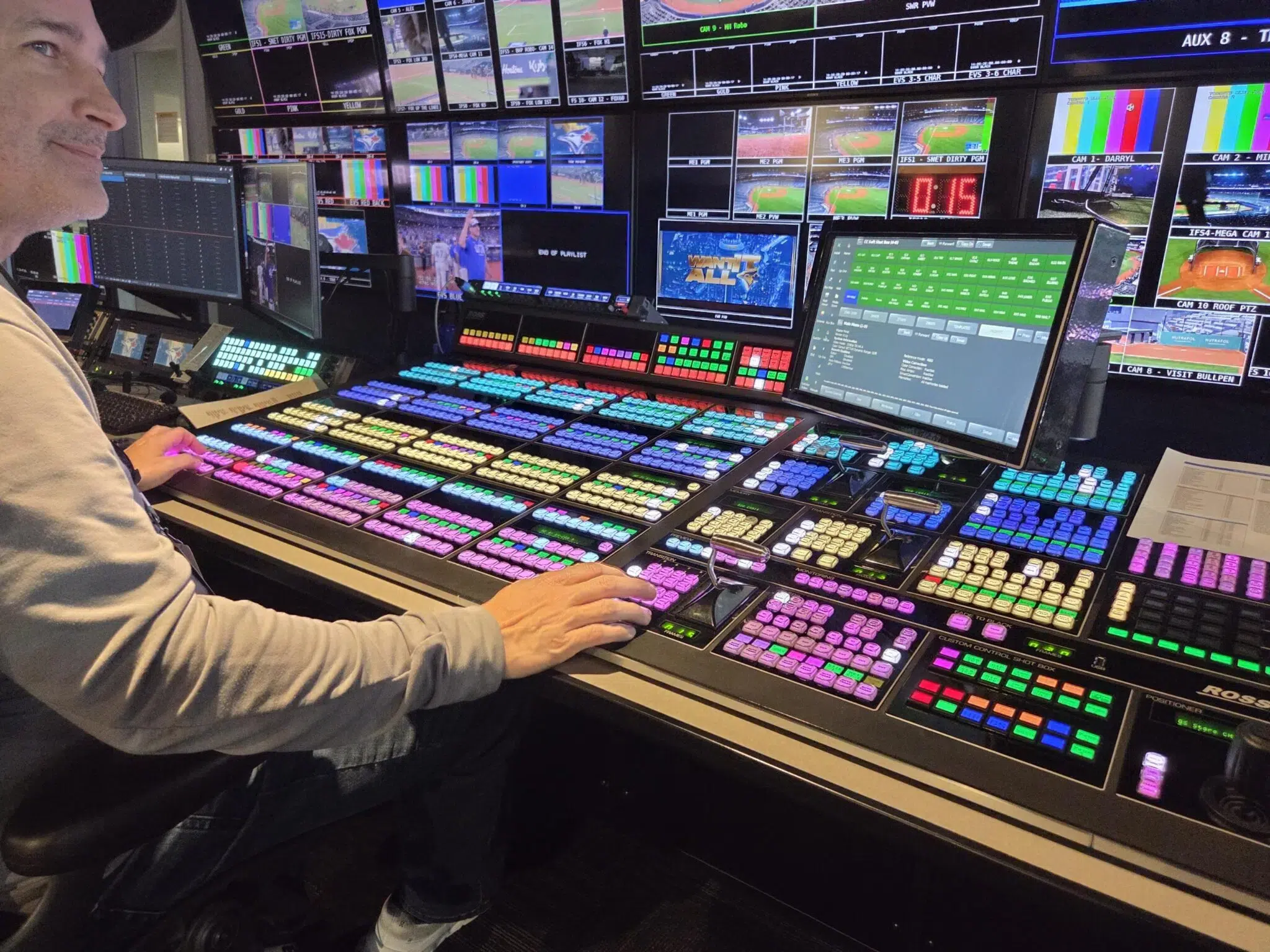
Ross Video’s Acuity production switcher drives the in-venue shows at the Rogers Centre
These aren’t just facility upgrades—they are strategic counter-moves to the convenience of the couch.
A Deloitte stadium survey found that fans who rate their game-day experience as “exciting and unique” are significantly more likely to attend more games that season. Season ticket renewal rates climb when venues introduce new experience enhancements. And on the revenue side, research suggests that well-planned venue technology investments can yield $1.50 to $2.00 in new revenue for every dollar spent.
The pattern is clear. Venues that treat fan experience as a production challenge—not just an equipment purchase—are pulling ahead.
What modern venue production actually requires
So what does it take to deliver this kind of synchronized spectacle? Based on what the leading venues are doing, a few requirements are non-negotiable.
- Unified control architecture. Operators need a single system that can trigger venue-wide effects across all displays, audio, and lighting. When the moment calls for a synchronized celebration, every screen should be showing the same replay, the lights should be flashing team colors, and the audio should be pumping. That should be deployed with the press of a single button, not a chain of manual cues across disconnected systems.
- Real-time responsiveness. Sports are unpredictable. A player breaks a record, and a momentum-shifting play happens in the final seconds. The production team needs to react instantly, pulling in replays, triggering graphics, and coordinating effects without delay. Systems that require manual handoffs between platforms can’t keep up.
- Data integration. Modern fans expect the same statistical depth in the stadium that they get on their screens at home. That means binding real-time stats, historical data, and next-gen tracking information directly to graphics—so a player’s speed, distance covered, or shot probability can appear on screen moments after the play happens.
- Scalable architecture. Not every venue is SoFi Stadium or Madison Square Garden. The production approach that works for a flagship NFL venue needs to be adaptable for college arenas, minor league ballparks, and smaller facilities. Venues shouldn’t have to choose between “premium but unaffordable” and “affordable but disjointed.”
The direction this is all heading is clear. As Kevin explains, we’re looking at a future where sports venue production operates more like a concert tour.

DashBoard is free software that enables you to monitor, control, and program your venue production technologies in simple-to-use, highly customizable control interfaces.
The arms race is on
The gap between the best venue experiences and the rest is widening. Fans who attend games at venues like SoFi Stadium, Mercedes-Benz Stadium, or Tottenham Hotspur Stadium walk away with a different expectation of what “going to the game” should feel like. Those expectations travel with them to every other venue they visit.
Meanwhile, the at-home experience keeps improving. Streaming platforms are investing in production quality. TV technology is getting cheaper and better. The bar for what makes live attendance worth it rises every year.
For venue operators, the message is straightforward. Bigger screens and more pixels aren’t enough. The venues that will thrive are the ones that treat game day as a production—unified, synchronized, and designed to deliver moments that fans can’t get anywhere else.
The technology to do this exists today. The question is whether venues are ready to unify their systems, rethink their workflows, and operate like the entertainment destinations they need to become.
Because the couch isn’t going anywhere. And it’s getting more comfortable every year.