The pressure on newsrooms isn’t going away. Audiences have migrated en-masse from linear TV to social and streaming. Staffing levels are declining across every market size. Output demands now span 10 to 14 publishing destinations (with a leaner staff). And the technology stacks underneath most newsroom operations—built from separate applications for ingest, editing, asset management, planning, and editorial—were designed for a linear-only world that no longer exists.
Most of these problems get blamed on budgets or headcount. But the deeper issue is that, for many newsrooms, producing a single piece of content still requires jumping between five to ten different software applications. No newsrooms—no matter how well staffed or funded—will be able to keep up with the rapid rate of consumption today when that’s what their workflows look like.
Ross Video built Indigo to fix it.
Launched at NAB Show 2026, Indigo brings ingest, editing, workflow automation, asset management, editorial, and playout together in one modular, browser-based platform.
As David Ross put it during his keynote address:

The problem Indigo was built to solve
Jenn Jarvis, Ross Video’s Solutions Manager for Production Workflow, spent eight years working in local news before joining the company thirteen years ago. She’s watched the pressures on newsrooms compound in real time, and felt the impact that those pressures have had on broadcast teams and output quality.
At the NAB Show 2026 keynote, she described that pressure like this.
Adapting constantly is hard enough. It gets significantly harder when every task in the production workflow lives inside a different application. “The professional content creator typically needs to access somewhere between five to ten software applications to create a single deliverable,” explained Jenn.
Any workflow will eventually collapse under its own weight as demands become more and more rapid and complex. Broadcast technology is no exception, and it’s becoming more apparent by the day.
Ross Video saw this same friction in its own product lineup. The company has offered three distinct products covering the production workflow:
- Media IO for ingest and playout
- Streamline for asset management
- Inception for editorial.
Each did its job well. But running them as three separate applications meant duplicating effort throughout the workflow, from development through to deployment. User rights, databases, planning tools, metadata management—the same capabilities were being rebuilt in each product when they could have been shared.
Indigo is what happens when you stop treating those as three products and start treating them as one end-to-end workflow.

AI and News Media Workflows in 2026
Leaders from Morgan Murphy Media, Graham Media Group, Ross Video and Fox Television Stations break down AI’s increasingly critical role in media operations across ingest to playout, capture to edit and multiplatform distribution in a TVNewsCheck Working Lunch Webinar.
One newsroom broadcasting platform from ingest to publish
Indigo puts the full content production workflow—including ingest, editing, workflow automation, asset management, editorial, and playout—into a single environment. One database. One web-based interface. All supported by modular capabilities that turn on when you need them.
Every Indigo deployment starts with a shared core that handles the foundational layer. This includes user rights, asset libraries, metadata, AI-powered tagging and search, MOS integration, monitoring, and APIs. From there, newsrooms can add the production modules that match what they actually need to do.
- Media I/O is the video server layer that enables ingest, playout, transcoding, scheduling, and playlist management. It connects Indigo to live feeds and broadcast infrastructure across SDI, ST 2110, and hybrid signal environments. If you’re running ganged playout across multiple channels, Media I/O handles that from the same interface you use for everything else.
- Create brings editing into the platform. There’s a browser-based web editor for fast-turn content and NLE plugin integrations for craft editing. Either way, editors work directly with media that’s already in the shared asset library. No exporting to a local drive, re-importing into a different application, or manually transferring files between systems. Content moves from ingest to edit to finished piece without leaving the platform.
- Workflow handles the automation that ties production stages together. Visual workflow tools let teams set up archiving rules, transcoding chains, and publishing destinations—including direct output to social platforms and CMS systems. This is where content actually gets routed to its destination without someone manually pushing it there.
- Planning is the coordination layer. Assignment managers build daily coverage plans, assign stories and tasks, and track progress, all within the same environment where the content is actually being produced. No more managing assignments in one system and checking production status in another.
- Lastly, Editorial brings native NRCS capabilities into the platform. This includes rundowns, stories, scripts, and wire integration. Journalists and producers work with familiar newsroom tools while staying connected to the same media, metadata, and workflows that power everything else in Indigo.
The editorial workflow isn’t a separate system that hands off to production. It’s part of the same environment.
Why Indigo’s architecture matters more than the feature list
The modules above describe what Indigo does. The architecture is what actually makes it different for your newsroom.
Indigo runs on a single database across all modules.
A clip ingested through Media I/O is immediately searchable in Create, visible in Planning, and accessible in Editorial. No file transfers. No re-ingestion. No re-entering metadata that was already tagged upstream. The content exists once, and every part of the workflow can see it.
Compare that to a traditional stack where each application has its own database, its own file storage, and its own version of the truth. This is all connected by integrations that someone has to build and maintain. And if they break—silos emerge.
To enable this connected environment, the entire Indigo platform runs through the Aura UI —Ross Video’s award-winning, entirely web-based interface. Every module and every function that the newsroom needs is accessed from a browser. No desktop clients to install. No application-specific interfaces to learn for each part of the workflow.
In a newsroom where one person might plan, shoot, edit, and publish in the same shift, not having to switch between five different applications with five different design languages is a huge efficiency gain, which can be channeled into better content production.
Under the hood, Indigo is containerized and Linux-based. It runs on-prem, in the cloud, or in hybrid environments. New capabilities are activated as needed through license keys, not hardware installs.
For the engineering and IT teams managing newsroom infrastructure, the math is simple. Indigo requires fewer servers, fewer databases, and fewer integration points that can break when a vendor pushes a firmware update. You have one platform to patch instead of coordinating updates across a half-dozen disconnected products.
Start with what you need, scale when you’re ready
Because it’s modular, Indigo doesn’t require buying the entire platform on day one.
A team can start with Core and Media I/O for ingest and playout, add Create when they want editing inside the same environment, turn on Planning when coordination needs grow, and unlock Editorial when they’re ready to bring their NRCS into the fold.
Each module is a license activation, not a new purchase order, not a rack of new hardware, not a six-month integration project.
This also protects existing investments. Indigo integrates over MOS with third-party newsroom systems, so teams using a non-Ross NRCS can take advantage of unified ingest, editing, and asset management without ripping out their current editorial tools. The migration happens on the newsroom’s schedule, not the vendor’s.
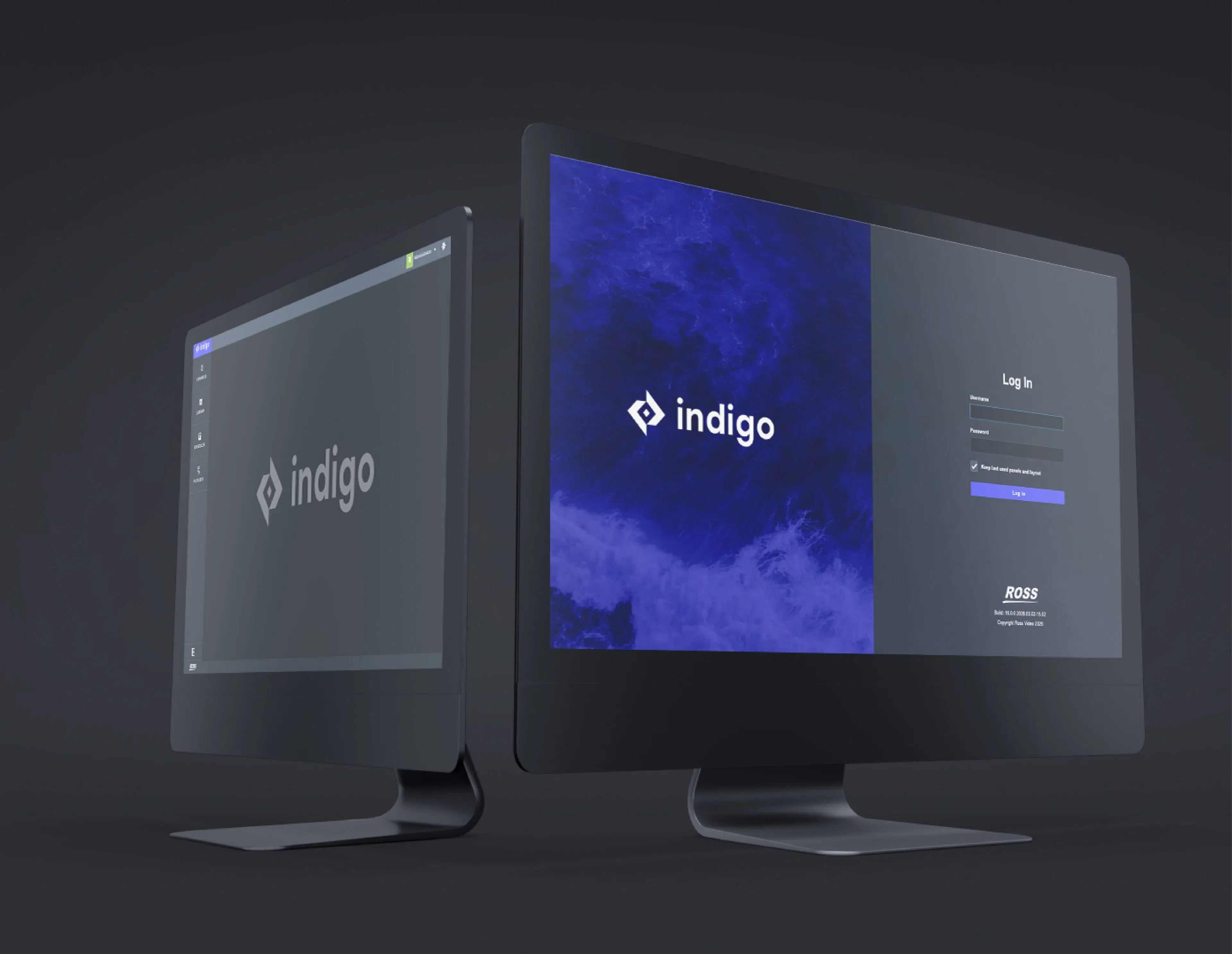
With Indigo, create fast-turn, digital-first content in one modular, browser-based platform
A clear path forward for existing Ross Video customers
For newsrooms already running Media IO, Streamline, or Inception, the move to Indigo isn’t a rip-and-replace. Jenn explained this this directly at NAB:
Existing workflows, media, and integrations carry forward. The upgrade brings those capabilities into Indigo’s unified environment, with the option to expand into additional modules over time.
For teams running a mix of Ross Video and third-party tools, existing integrations stay in place/ And as those other products come up for renewal, consolidating into an Indigo module is always on the table.
Indigo is built on a proven technical foundation
Indigo is new. But the technology inside it is not.
The ingest and playout engine behind Media I/O, the asset management workflows from Streamline, and the editorial tools from Inception have all been developed and tested across years of live deployments in broadcast newsrooms, sports production, and professional content environments.
Indigo brings the best of that work together under one roof—unified, modernized, and shaped around the workflows that newsrooms actually use.

Built for breaking news
Move faster, keep consistent, and deliver more compelling stories with a newsroom solution purpose-built for the modern 24/7 news cycle.
Ross Video brings together everything you need — graphics, robotics, control and automation — into a single, reliable workflow that makes multiplatform delivery simple.
A new chapter for newsroom production
The newsroom technology landscape has reached a breaking point. Audiences have moved, teams have shrunk, and the number of platforms on which users get their content keeps climbing.
The patchwork of disconnected tools that got newsrooms through the linear era is now the thing slowing them down most.
Indigo is Ross Video’s answer. One database and interface. Modules that turn on when you need them. And the flexibility to run wherever your infrastructure lives—on-prem, cloud, or both.
As David Ross said: “Indigo is far greater than the sum of its parts. This powerful enterprise software represents an exciting new chapter for Ross and our customers.”
For newsrooms ready to stop stitching tools together and start working in one connected platform, that chapter starts now.
Contact Ross Video to learn more about Indigo and how it fits your production workflow.