The corporate video studio budget conversation often feels like déjà vu. Same script, same ending.
You come to the planning meeting prepared to explain why the studio needs investment. The equipment is getting old, the space could be improved, and the team could work more efficiently. Still, after all your effort, the budget gets cut because no one wants to add another sunk cost. The same thing happens every cycle.
It might seem like the studio isn’t valued, but that may not be the real issue. The pitch may have focused on equipment cost and efficiency without showing the wider business value the studio supports. Companies that invest in their studios recognize them as strategic communications assets with benefits extending across the organization.

Why finance may see your studio only as a cost center
Production infrastructure is usually budgeted as capital for internal communications and is seen as sitting unused the rest of the time. The justification often relies on vague ideas about efficiency, like needing certain tools to work faster. When the focus is only on features, the full benefits never make it into the business case, and your CFO can’t see how the investment leads to revenue.
But the right environment helps the business create stronger executive and investor communications, support live interviews with financial and industry experts, produce marketing content, deliver client briefings, and run events that contribute to commercial activity. These outcomes may enable revenue and protect brand value even when the studio does not generate revenue directly.
That oversight matters more every year, because video has moved from the back office to the front of how a company presents itself. AVIXA points to two forces driving corporate demand at once—the hybrid workplace and the experience economy—and notes that organizations increasingly treat their corporate events as capturable, shareable content rather than one-off gatherings. The studio isn’t producing internal housekeeping anymore. It’s producing the brand’s public face, and often its investor-facing one.
For the AV leader, that shift is the new budget pitch. The case for the studio stops being a maintenance request and becomes a strategy conversation, one that marketing has a direct stake in and one that finance evaluates differently. The rest comes down to making that case on both sides of the ledger.

Free Report: Broadcasting the Boardroom
See how other enterprise AV leaders are reducing outside production costs, supporting lean teams, and turning studios into business assets.
The hidden cost of a mediocre production
The first thing the cost-center frame hides is that production quality is not cosmetic. A mediocre production isn’t a neutral outcome that saved a bit of money. It’s an active withdrawal from brand equity, and audiences react to it whether or not they could name why.
The consumer data on this is clear. After a poor digital experience, 55% of people abandon a purchase, 50% switch to a competitor, and 39% cancel a subscription, according to Conviva’s 2025 State of Digital Experience Report, which pairs a survey of 4,000 consumers with data from hundreds of millions of viewing sessions.
The same research shows that every 1% drop in experience quality leads to about 1% more churn. Quality isn’t a box you check once. It’s something you have to keep delivering.
That consumer reaction extends specifically to video. 89% of consumers say video quality affects how much they trust a brand, according to Wyzowl’s 2026 research. And the bar audiences hold you to is now at professional broadcast levels. Enterprises themselves report that stakeholders expect broadcast-standard quality and that a corporate stream has to clear the bar set by everything else on the screen.
The internal audience is just as critical. Every town hall, investor call, and client briefing is a brand impression. A mediocre one comes with a cost that your finance or marketing team may not fully register unless you spell it out for them.
Production quality is a competitive edge.
Production capability isn’t only about protecting your brand. It can also support the work that wins and retains business. If you can deliver professional-quality events and content whenever needed, you have a valuable business development and communications asset. Marketing leaders already understand this.
Events are where this shows up most clearly. In a study of 198 B2B companies spanning millions of deals, 52% of marketers attributed at least half of their closed-won revenue to events, and 78% called in-person conferences their single most impactful marketing channel, according to HockeyStack’s 2025 State of Event Marketing. Simply put, prospects who attend these tend to close faster.
When any share of closed deals involves an event, the quality and consistency of those interactions deserve attention across departments. That does not mean the studio alone created the revenue, but it can be an important part of the wider client experience and content operation supporting the pipeline.
For both AV and marketing teams, the message is clear. If you can produce professional-quality events, launches, executive interviews, or client briefings in-house on your own schedule, you have a capability that can strengthen communications and support commercial activity. External partners can still add valuable capacity and specialist expertise for unusually complex or location-based events.

From cost center to productive business asset
The third reframe is utilization. A studio built for the brand can support a much wider range of work between major internal events: executive interviews, investor and analyst communications, marketing content, client briefings, training, partner sessions, and hybrid events.
It’s important to be honest about the value. These activities generally enable the business rather than create a standalone studio revenue stream, and their contribution should not be presented as guaranteed direct income.
Some organizations may also be able to host partner, client, or industry events in their facilities. That opportunity depends on location, demand, security, staffing, and the organization’s operating model, so it should be tested as a specific use case rather than assumed from the commercial studio-rental market.
The stronger business case is therefore broader utilization: one permanent environment supporting more communications, more content, and more high-value interactions. Any direct rental or event income should be presented as optional upside only when the organization has evidence of demand and a workable delivery model.
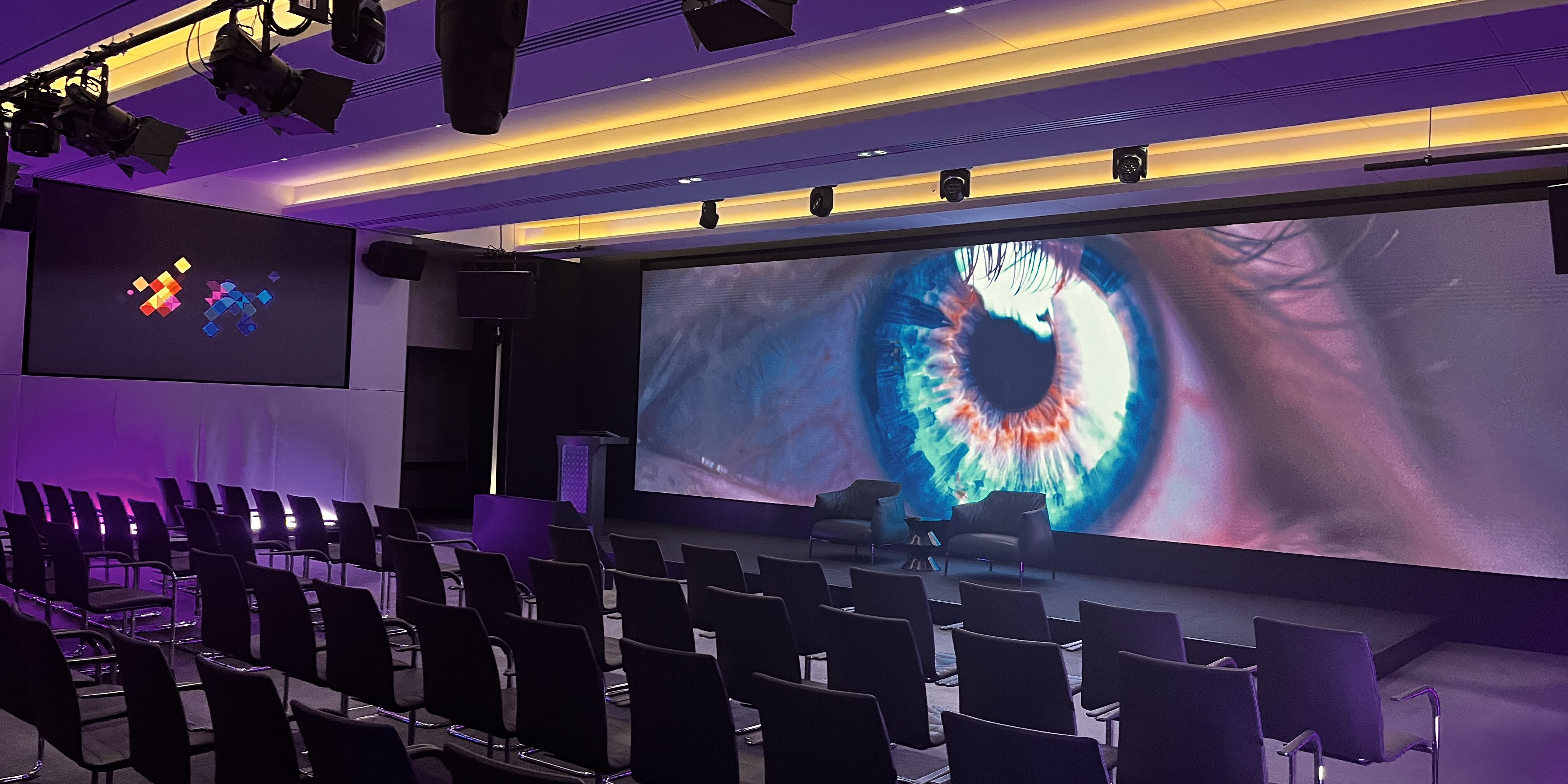
Raising the bar for financial communications
See how one of the world’s leading asset managers has invested in a Broadcast AV solution to meet the growing demand for live corporate communications
How to make your case to finance and marketing
To win new budget for your AV studio, your pitch should show both the costs you avoid and the value you create, and it should speak to both finance and marketing at the same time.
For finance, the goal is to shift the studio from being seen as just a capital expense to being viewed as an investment that brings returns.
To do that, focus on:
- Total the current spend. The money is going out the door either way—per event, per crew, per rental—it just never shows up as a single line anyone scrutinizes. Add it up across a full year and put it next to the investment.
- Reframe the ask as consolidation. Presented against existing spend, the studio stops being a new cost and becomes a consolidation of one the organization already carries, with a payback timeline finance can evaluate.
- Label the upside honestly. Brand protection, deal velocity, and rental optionality won’t all carry hard numbers on day one, but they belong in the case as clearly marked upside. They’re the difference between a maintenance request and an investment thesis.
For marketing, the pitch is about business enablement. When events and content play a meaningful role in the customer journey, the environment supporting them can help marketing deliver more consistently, respond more quickly, and protect the brand at high-visibility moments.
- Bring them in before the planning meeting. A case with two departments behind it reads as strategy. Show how the studio contributes to the wider marketing operation without claiming sole credit for revenue. Event pipeline, content output, speed to market, and brand consistency can all support the case, provided the connection is described and measured honestly.
- Pitch the studio in their metrics. Event pipeline, content output, brand consistency—the same room that saves AV money produces the assets marketing is accountable for.
There’s an important point to remember. None of these benefits matter if the studio can’t meet quality standards. The advantages are only real if the output is truly broadcast-grade, reliable for important brand moments, and can be run by a small in-house team whenever needed. If a client keynote looks like a basic webcam and slide deck, the revenue argument quickly turns back into a cost issue.
This means a key part of your pitch should be a clear explanation of how you’ll use the new budget to improve and maintain quality on a large scale.
If you frame your case correctly, the yearly budget conversation becomes easier and more strategic. The AV leader stops defending a room and starts presenting an asset, with marketing involved and finance looking at returns instead of just cutting costs.

Show the business value a studio enables.
Studios that get reinvestment aren’t necessarily the ones with the best equipment or the boldest revenue claim, or even a great efficiency claim. They are the ones understood as strategic communications assets before the budget meeting. As corporate events become shareable content and audiences judge brands by their productions, the studio can protect the brand, expand communications capacity, and support the interactions through which business value is created.
Are you ready to bring your production in-house?
Many of the barriers that once existed to bringing recurring corporate video production in-house have fallen. But that doesn’t mean every production belongs in-house or that the decision is easy. It’s a major shift involving the CFO, human resources, IT, communications, and leadership teams. It’s an upfront cost and a commitment—but one that can pay dividends in the future.
Plenty of organizations are still writing five-figure checks several times a month for recurring productions that a permanent internal platform could support. That is an expense worth comparing with the cost and value of building an internal capability, while retaining external expertise for events that genuinely require it.
The organizations that work this out first won’t frame it as a simple technology or insourcing decision. They’ll identify which recurring productions are suitable to own, which exceptional events still benefit from outside expertise, and what the resulting operating model means for the budget. The question for the next planning cycle is what continuing to outsource the repeatable core is costing—and whether there is a more sustainable way to spend that money.
To learn more about how to turn your production studios into a business asset, reach out to a Ross Video expert here.