The corporate production calendar used to be steady and predictable. A few marquee events per year, each big enough to justify booking an outside crew and paying full freight for a day of broadcast-quality video. That world is largely gone.
Companies are now leaning heavily into live video production. A single month may now bring a town hall, an investor briefing, a customer event and a launch video. And for many enterprises, every one of those still goes out to an external production company that charges tens of thousands of dollars per session.
The trouble with this isn’t the price of any one event. It’s that every fully outsourced production is a fresh transaction. Do that thirty or forty times for recurring, standardized productions, and you’ve spent a fortune chasing an ever-growing events calendar rather than building an in-house core capability. External partners may still be the right choice for exceptional productions, but they do not need to be the default for every repeatable show.
So how do you reduce repeated dependence on outside production? You shift from renting every recurring show to owning the core capability through a platform that a small internal team can actually run. That’s what Ross Video’s production ecosystem is built for, and what this article will explore.

The outsourcing model wasn’t built for how often you produce now
Outsourcing corporate video production made sense when live video was occasional.
You got a professional result without carrying gear or payroll. And that high cost landed just once or twice per year—something that your CFO could easily budget for in advance.
The frequency of live video production has effectively broken that model. Since remote working exploded during the pandemic, this type of content has become a staple of enterprise communications worldwide, creating extensive demand for video production equipment and talent.
In fact, 98% of US and UK enterprises now use live streaming for key communications events, and 45% call it critical for how they communicate. If you ride this demand to its peak, but don’t shift your production model, then you’re looking at major and unpredictable outsourcing bills on an annual basis.
Every fully outsourced event remains a fresh five-figure transaction. The production crew leaves and the gear goes back; although the partner has provided valuable expertise and delivery capacity, the organization owns no permanent workflow or infrastructure that makes the next recurring event cheaper or easier.
That model needs to shift to account for the new demands of corporate video production. But it’s worth being clear-eyed about what that means.
What in-house production actually takes
Bringing the repeatable core of production in-house only works if it clears some very specific criteria for video production and reliability. The goal is not necessarily to replace every external resource: specialist crews, managed-service providers, and production companies may still add capacity or expertise for unusually large, complex, or location-based events. The goal is to reduce the dependence on them for regular or routine updates, allowing corporate communications to create more, high-quality content without the expense.
Here’s what any in-house production crew needs to achieve:
- It has to scale with the calendar, running a two-camera town hall and a full multi-camera launch on the same platform without a rebuild.
- It has to hold broadcast quality consistently across every format and room.
- It has to be operable by a small, non-specialist team.
- It has to be genuinely broadcast-grade, because the audience’s quality bar is set by everything else they watch.
- It has to be supported well enough that a lean team is never left exposed in the middle of a live event.
If your in-house build doesn’t consistently clear all of these requirements, it will likely fail in the long term. So it’s not just a matter of buying equipment and running a production. It’s an entirely new investment and capabilities that you need to build and grow with your team.
The difference between a capability you own and an expensive pile of gear is meeting all five at once, which is where the case for a single integrated ecosystem, rather than a stack of separately sourced boxes, starts to matter.
This is what Ross Video offers.

8 common misconceptions about enterprise audio-visual investments
Avoid the misconceptions and traps that many enterprises fall into when investing in new enterprise audio-visual systems with the help of our panel of partners and experts in this article.
How Ross Video makes in-house production work
Ross Video delivers in-house corporate video production as one integrated ecosystem rather than a collection of hardware vendors that need to be jerry-rigged together.
The switching runs on Carbonite, the signal infrastructure on Ultrix, control is unified through DashBoard, and the whole thing is backed by round-the-clock support.
Here’s how it all comes together to enable in-house video production for enterprises.
Carbonite: The production switching backbone
Let’s say your lean team needs one switcher that can run a town hall on Monday and a product launch on Thursday without being reconfigured in between.
That’s the job Carbonite is built for.
Carbonite Ultra folds the equipment a production normally spreads across a rack—like frame syncs, format conversion, multiviewers, keyers, and an audio mixer—into a single small (1RU) frame, so a lean team isn’t managing a room full of separate devices to put one show on air.
When the event gets bigger, the platform scales with it rather than against it.
Carbonite Ultra 60 reaches around 60 inputs and 25 outputs with three full MEs, enough for an ambitious multi-camera broadcast, and its ViewControl system lets operators without broadcast-engineering backgrounds run complex shows with confidence. The switcher does the heavy lifting so the operator doesn’t have to be a specialist.

Carbonite Ultra 60 production switcher engine, combined with the intuitive TouchDrive control panel
Ultrix: Signal infrastructure without the vendor sprawl
Multi-vendor routing is where most in-house builds get fragile and expensive. Every added device is another integration point, another format to convert, another thing to fail during a live show.
Ultrix removes most of that surface area by integrating routing, signal processing and switching into one format-agnostic platform that handles any mix of SDI, ST 2110, NDI, Dante and MADI.
The practical effect is fewer boxes, less rack space and lower power draw, which lowers both the capital cost and the number of ways a production can break. Its unique removable blade design means it’s easy to modify, add new tools, or upgrade without having to replace the entire machine.
Ultrix is the plumbing that keeps a lean in-house build simple enough for a small team to actually own. It’s the unglamorous layer that determines whether everything above it stays reliable.
DashBoard: One control surface
A small team can’t be jumping between five separate control applications while a show is live. DashBoard unifies control and monitoring of the whole production in one customizable interface. It’s what allows just a couple of operators to run a professional-grade broadcast that would traditionally have taken a full gallery. It’s the layer that ties the lean-team story together, and it’s one that Ross Video’s own deployments lean on heavily.

DashBoard unified production control software
24/7 support: The backup
Even with the best tech stack, there’s always the fear of what happens when something goes wrong during a high-profile event.
Our solution to that fear is to offer clients 24/7/365 on-call support and a 24-hour hotline staffed by our own expert personnel, plus commissioning and operational training that hands your internal team genuine ownership of the platform.
This is the requirement most technology comparisons skip, but it’s the piece that decides whether running corporate video production in-house is safe or reckless. A small team can operate broadcast-grade production confidently only when it knows the support is there the moment something goes wrong.
The world’s top organizations use Ross Video
With Ross Video, you don’t just get world-class hardware and renowned professional support—you sit alongside some of the world’s biggest and most technically advanced broadcasters and blue-chip enterprises that use our products and services day in and day out.
One of the world’s leading asset managers working from its London headquarters, for example, ran exactly the outsourced model described above. Every show needed four or five freelancers, and the auditorium used for these events had effectively become a cost center. After building an in-house environment on Ultrix, Carbonite, TouchDrive, XPression and DashBoard, the same events run with two in-house staff, and the quality went up rather than down.
The deployment broke even within 18 months and now saves roughly £1 million a year. This follows the broader pattern we see across enterprise insourcing, where an outside crew of 10 to 15 people is reduced to an internal team of two to three once the platform, templates, and workflows are standardized. The same auditorium has become a more productive business asset instead of a cost center, supporting more events with greater control over quality and delivery.
Why one ecosystem beats a multi-vendor stack
The reason to source this as one ecosystem rather than assembling it from separate vendors comes down to cost and reliability, the two things a lean in-house operation can’t compromise on.
Fewer vendors means fewer integration points to engineer and maintain, more predictable capital and operating costs, and a lower total cost of ownership over the life of the system. It also means one line of accountability when something goes wrong, instead of a standoff between suppliers each pointing at the other.
An integrated platform is what makes lean, in-house production reliable rather than risky—and reliability is the whole reason to bring it in-house in the first place.
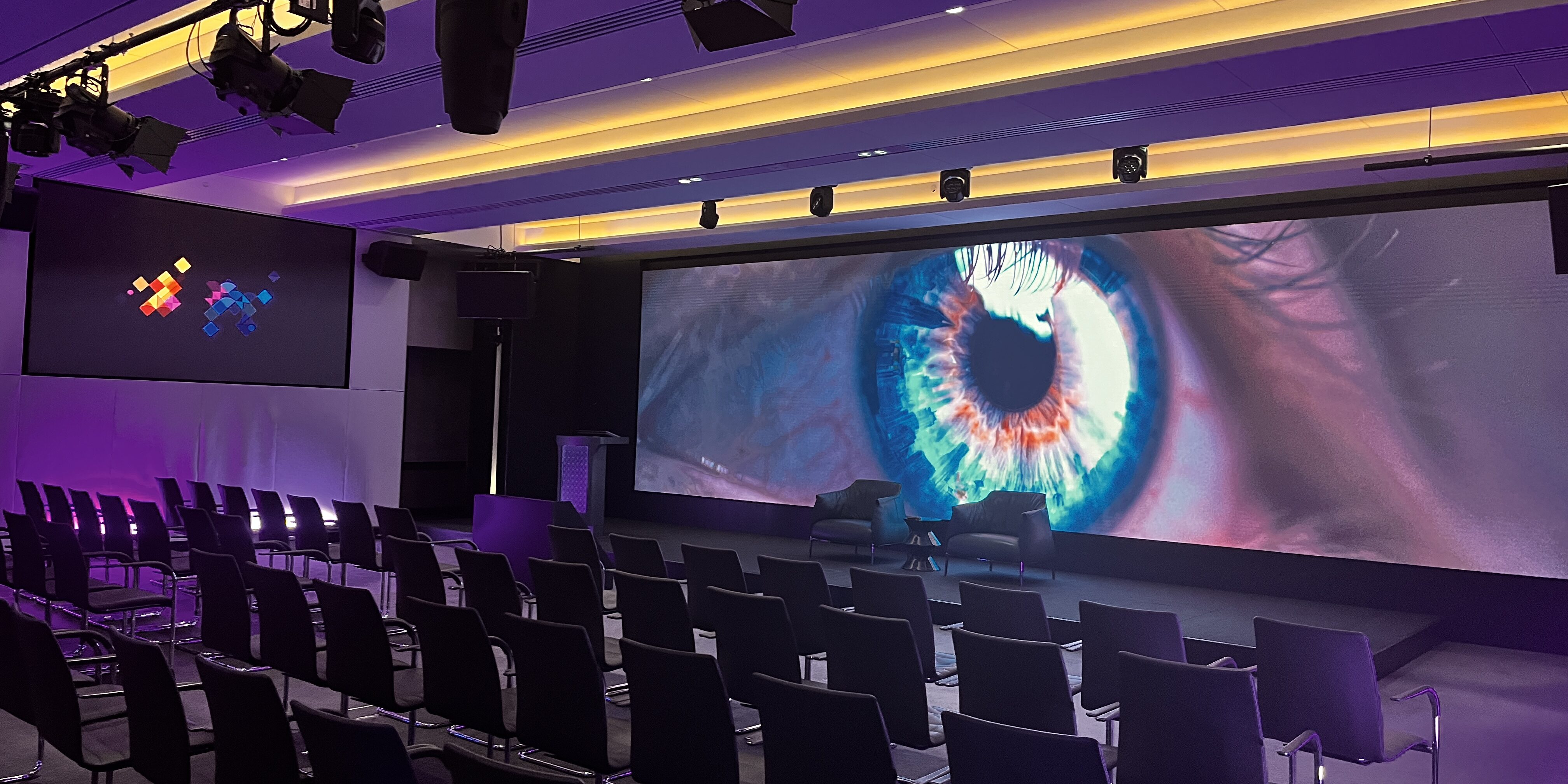
Raising the bar for financial communications
See how one of the world’s leading asset managers has invested in a Broadcast AV solution to meet the growing demand for live corporate communications
Own the repeatable core of your production
This decision is about identifying where repeated outsourcing costs are no longer justified and where external expertise still adds genuine value. Ross Video addresses the technical and operational hurdles involved in owning the recurring core; the next step is to run the numbers and determine which productions make sense for your organization to handle internally.
If the recurring part of your production calendar has outgrown a fully outsourced model, it’s worth scoping what an in-house core would look like for your organization—and how it could continue to work with external specialists when an event requires them.
Learn more about how Ross Video helps our enterprise customers successfully bring their live video production in-house by speaking with one of our experts here.